
French Roulette Online Casinos in the UK
 Available in GB
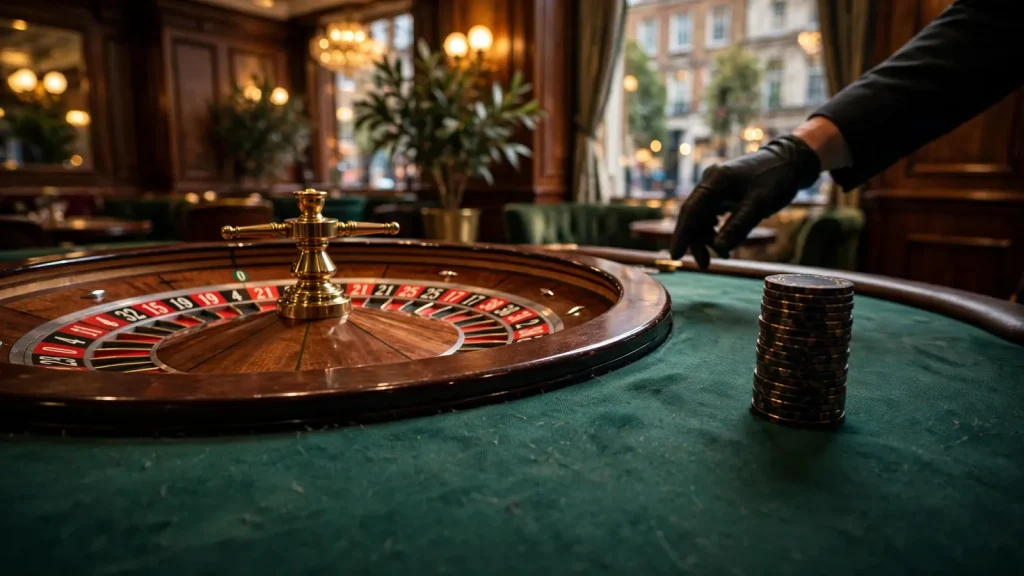
See how French roulette rules affect eligible bets, and how live and RNG formats, table limits and bonus conditions differ.
Table of Contents
- How French Roulette’s Rules Shape the Odds
- Comparing French Roulette Casinos Without a Ranking
- Live French Roulette: Physical Wheels and Table Pace
- Low-Stakes Tables, Standard Limits and Faster Formats
- RNG French Roulette Online: What the Format Changes
- Finding French Roulette Among UK Casino Games
- Premium Tables and the Limits of the Available Evidence
- Roulette Bets and Payouts in the Casino Game
- Playing French Roulette Online: Risk and Betting Systems
- Casino Roulette Bonuses and Wagering Conditions
- Games
How French Roulette’s Rules Shape the Odds
French roulette’s odds begin with the wheel. Its European layout has 37 pockets: the numbers from 1 to 36 and one zero. The zero matters because it gives the house an advantage over time. On a standard European wheel, the house edge is 2.70%. That figure describes the game’s mathematical advantage across repeated play, not a prediction of what will happen in any individual spin.
French roulette uses rules that alter how certain wagers are settled when the ball lands on zero. The most direct of these is La Partage. On an even-money bet, such as red or black, the rule returns half the stake if zero appears. Without that adjustment, the zero causes the whole wager to lose. With La Partage, the loss on that outcome is reduced, and the house edge on those bets falls to 1.35%.
The reduction applies to the eligible even-money wagers, not to every bet on the table. A bet on a particular number, for instance, does not become an even-money bet simply because the wheel is French. The relevant distinction is the type of wager and the table’s stated rules. The French label alone is not enough to establish how every bet will be treated; the rules shown for the game determine whether La Partage applies.
When choosing a UK casino for French roulette, it is worth checking practical details alongside the game itself. The available information here focuses on payout speed.
1. Dieselwin
Payout speed: 1-3 business days Dieselwin lists a payout speed of 1–3 business days.
2. x3bet
Payout speed: 1-3 business days x3bet lists a payout speed of 1–3 business days.
3. Britsino
Payout speed: 1-3 business days Britsino lists a payout speed of 1–3 business days.
4. Revery Play
Payout speed: 1-3 business days Revery Play lists a payout speed of 1–3 business days.
5. Chanze
Payout speed: 1-3 business days Chanze lists a payout speed of 1–3 business days.
6. Amunbet
Payout speed: 1-3 business days Amunbet lists a payout speed of 1–3 business days.
7. BeOnBet
Payout speed: 1-3 business days BeOnBet lists a payout speed of 1–3 business days.
8. Zombillion
Payout speed: 1-3 business days Zombillion lists a payout speed of 1–3 business days.
9. Jetsetspins
Payout speed: 1-3 business days Jetsetspins lists a payout speed of 1–3 business days.
10. WinBeast
Payout speed: 1-3 business days WinBeast lists a payout speed of 1–3 business days.
En Prison is another rule associated with French roulette. It changes the treatment of an even-money wager when zero lands, rather than making the wager an ordinary settled loss at once. Together, En Prison and La Partage give French roulette its lower house edge among standard variants. The size of that advantage should not be assumed to be identical across every bet: La Partage’s stated 1.35% edge concerns even-money bets, while the overall European roulette figure is 2.70%.
These figures describe different levels of the game. The 2.70% figure is the house edge for European roulette as a whole; the lower figure applies to qualifying even-money wagers when La Partage is in effect. Confusing them can make the rules appear either more or less favourable than they are. A table may use the European wheel while applying a French rule to eligible bets, so the wheel layout and the bet-settlement rules both matter.
A lower house edge does not change the random nature of a spin. It indicates a smaller mathematical disadvantage for the player over repeated wagering under the specified rule, not a reliable route to a return on a particular session. The ball can land on any pocket, and a short run of results need not resemble the long-term expectation. The rule changes the consequences of zero for certain wagers; it does not influence where the ball will land.
Fastest Payout Online Casinos UK: What Timing Means
This distinction is useful when examining French roulette online. The name identifies a style of play, but the practical odds depend on the wheel and the rules that govern the wager. A European wheel has a single zero, while La Partage and En Prison affect the settlement of eligible bets. Where a game’s displayed rules specify which rule is active, those details clarify what happens after zero; they should not be inferred solely from a title or promotional description.
French roulette’s lower edge therefore comes from rule design rather than from a different probability of the ball landing on a number. The wheel retains the European arrangement, while the French rules soften the result of zero for qualifying even-money bets. La Partage makes that effect measurable at 1.35% on those wagers. En Prison also contributes to French roulette’s position as the standard variant with the lowest house edge, although that general comparison should not be mistaken for a single edge applying to every bet.
For a UK player considering a French roulette casino, the essential comparison is not just whether a game is labelled French. It is whether the stated rules include La Partage or En Prison and which wagers those rules cover. Those points define the relevant odds more precisely than the game name alone. The central mechanics remain straightforward: a 37-pocket European wheel, a zero that creates the house advantage, and French settlement rules that reduce that advantage for specified wagers.
A lower house edge does not change the random nature of a spin or provide a reliable route to a return on a particular session.
Comparing French Roulette Casinos Without a Ranking
A comparison of French roulette casinos is more useful when it examines verifiable features than when it assigns operators an unsupported order. The same game name can appear across different platforms, but the name alone does not establish which rules apply, whether the game is available in the advertised format or how its return information is presented. A sound assessment therefore separates the game’s mathematical terms from the operator’s regulatory and disclosure practices.
Start with the game’s rules and return information
French roulette is distinguished by La Partage and En Prison, rules that give it the lowest house edge among standard roulette variants. European roulette has a house edge of 2.70%; the French rules can reduce the edge on eligible bets. This describes the game’s theoretical odds, not a promise about an individual session or a measure of the casino’s overall quality.
The table rules should be visible before play. The label “French roulette” is not sufficient evidence on its own: the information displayed for the specific game should make its rules clear, including how La Partage and En Prison are applied. If the rules are difficult to locate or do not explain the treatment of bets when the ball lands on zero, the game’s stated name cannot resolve that uncertainty.
Return to player (RTP) information is another relevant point of comparison. UKGC-licensed operators should make the applicable game information accessible, so a comparison can check whether the RTP is stated for the particular roulette game and whether it corresponds to the rules shown at the table. A general RTP figure for a casino or for roulette as a category would not establish the return of a specific French roulette game. Where no game-specific figure is available, that should be recorded as a disclosure gap rather than filled with an estimate.
Fast Payout Casinos in the UK: What Can Be Verified
RTP and house edge express related theoretical properties, but they are not substitutes for checking the table’s rules. An RTP figure without a clear game identity or rule set may be difficult to interpret. Conversely, the French label and familiar rules do not provide an operator-specific RTP figure. A careful comparison keeps these pieces of evidence distinct.
Confirm the operator’s UK status
Regulatory status is a basic condition, not a quality badge. The UK Gambling Commission regulates online casino activity in Great Britain. Remote gambling operators selling into the British market must hold the relevant UKGC licence; a platform without a valid UKGC licence cannot legally offer real-money live roulette to British residents. The licence should be checked against the Commission’s public register rather than inferred from a UK-facing website, branding or a claim in promotional material.
A licence establishes that the operator falls within the UK regulatory system; it does not show that a particular roulette game has better odds. Nor does it replace a review of the game’s own rules, RTP disclosure or account conditions. Keeping those questions separate avoids treating regulatory compliance as evidence of a mathematical advantage.
Account protections also provide verifiable comparison points. Operators must verify a customer’s age before allowing deposits, and remote operators must prompt new customers to set a financial limit before their first deposit while providing accessible account-level limit controls. UKGC-licensed live casino operators must offer deposit and loss limits, session time reminders, reality checks, cool-off periods and GamStop self-exclusion. These protections concern the service surrounding the game, rather than the probability of a roulette outcome.
Do
- Check the operator’s licence against the UKGC public register
- Verify the game-specific RTP and table rules
- Set financial limits and session reminders
Don’t
- Infer regulatory status from branding or promotional claims
- Use a general casino RTP as a measure for a specific game
- Treat regulatory compliance as a mathematical advantage
The operator should also provide an internal complaints process and access to an approved Alternative Dispute Resolution service. Such procedures offer a defined route for raising a dispute; their existence does not determine how a casino will resolve a particular complaint. Likewise, a casino’s published policies can be compared for clarity, but broad claims of customer support do not substitute for specific, accessible terms.
Compare evidence, not promotional labels
For a practical assessment, the relevant record is concise: the operator’s UKGC status, the named game and its rules, the availability of game-specific RTP information, and the account protections and complaint routes described by the operator. This makes it possible to distinguish a casino that discloses the necessary details from one whose presentation leaves important questions unanswered.
No single feature proves that an operator is the best choice for French roulette. A low house edge belongs to the game’s rules; it is not a claim about the casino’s service, and it does not remove the need to confirm which version is being offered. Similarly, clear disclosures and regulatory status are meaningful safeguards, but they do not alter roulette’s chance-based outcomes. The strongest comparison is therefore not a league table: it is a transparent account of what can be checked for each offering, with unresolved details left unresolved.
Live French Roulette: Physical Wheels and Table Pace
A live French roulette table combines the rules of the French variant with a streamed game run by a human dealer. The camera shows a physical wheel and the ball being spun and dropped, rather than a result generated by a random number generator. This makes the process visible, but the stream does not change the underlying chance-based nature of roulette.
Best Keno Casinos Online in the UK: What to Compare
The distinction matters when comparing live play with automated versions. A live table includes the dealer’s actions and the time needed for betting to close, the ball to settle and the result to be recorded. That sequence sets a natural pace. A specialist review reports a range of 80 to 100 spins per hour for a standard table, while describing speed roulette as capable of exceeding 150 spins per hour. These figures are a comparison of formats, not a guarantee of the pace at any particular table. Dealer procedures, interface design and pauses can affect the number of completed rounds.
A faster stream should not be treated as a better way to play. More rounds in a given period mean that decisions and wagers occur more frequently; the visual presence of a dealer does not make outcomes predictable. The physical wheel can make each spin easier to follow, but it provides no basis for anticipating where the ball will land. The same distinction applies to a live auto-roulette casino: an automated interface may reduce pauses, but that does not make a streamed physical game equivalent to RNG roulette.
A table labelled French roulette is not defined solely by its live presentation. The game rules and betting options remain important, so the table information should identify which version is being offered. Live play describes how the round is conducted; it does not, by itself, confirm the rules attached to the table. A stream can therefore be assessed on two separate points: whether it uses a real wheel and dealer, and whether its stated game rules correspond to French roulette.
Live roulette pace varies by format, with standard tables typically seeing 80 to 100 spins per hour, while speed roulette can exceed 150 spins per hour.
For British customers, real-money live roulette must be offered by an operator holding the relevant UK Gambling Commission licence. The Commission is the regulator responsible for online casino activity in Great Britain. A platform without a valid UKGC licence cannot legally offer real-money live roulette to British residents. Age must also be verified before an operator allows a customer to deposit funds. The licence number can be checked against the Commission’s public register before an account is funded.
UKGC-licensed operators must provide safer-gambling controls for live casino customers, including deposit limits, loss limits, session time reminders, reality checks, cool-off periods and access to GamStop self-exclusion. These tools operate at account or session level; they do not alter the game’s rules or influence the next spin. Operators must also provide an internal complaints process and access to an approved Alternative Dispute Resolution service.
The live format is therefore best understood as a presentation and pace choice, not as a separate form of protection or an indication of more favourable outcomes. A physical wheel and human dealer distinguish it from RNG play, while the operator’s licence and account safeguards determine the regulatory conditions under which real-money play is offered. A French roulette label still needs to be read alongside the table’s stated rules, and the speed of the stream should be considered separately from those rules.
Classic Slots Online in the UK: How They Work
Low-Stakes Tables, Standard Limits and Faster Formats
A low entry stake and a low house edge are separate features. The minimum shown for a roulette table describes the smallest permitted wager, not the price of playing over a session or the probability of a particular result. For French roulette, the available minimum can depend on the format and the specific table; a low-stakes label alone does not establish that every French roulette game at a casino has the same threshold.
A specialist review reported live roulette minimums beginning at 10p, with some auto-roulette and speed tables allowing a 5p opening stake. These are reported examples, not a guaranteed schedule across UK casinos. Table limits should therefore be read from the game information before play, since a minimum attached to one table does not establish the minimum at another.
The format affects pace as well as the entry point. At a live table, a dealer operates a physical wheel in a streamed studio, and the rate of play is reported at 50 to 60 spins per hour. RNG American roulette has been reported at 150 to 200 spins per hour or more. That comparison concerns the number of rounds, not the size of each wager or the outcome of any spin. A faster game can allow more betting decisions within the same period, so a small minimum should not be treated as a measure of total exposure.
Auto-roulette and speed formats occupy a different practical position from a conventional live table. Their reported minimums can be lower, and speed roulette is designed to move through rounds more quickly. In particular, the term “standard limits” does not identify a fixed UK-wide range. A table’s displayed minimum and maximum are more informative than a broad category name.
Live Table
Features a human dealer and physical wheel with a reported pace of 50 to 60 spins per hour.
Auto-Roulette
An automated interface that can reduce pauses and offer lower minimum stakes starting at 5p.
Speed Roulette
Designed for faster rounds, capable of exceeding 150 spins per hour with potential 5p opening stakes.
For someone comparing a low-stakes French roulette casino, the relevant check is whether the individual game is French roulette and what minimum applies to that table. A low entry point on an auto-roulette game, for instance, cannot by itself establish that the game uses French rules. Nor does a higher minimum imply that a table is more favourable: the stake limit and the rules governing the wheel are different properties.
The same caution applies to high-limit descriptions. Such labels should not be read as evidence of a particular limit structure or advantage. A comparison is meaningful only where the individual table’s terms make its permitted stakes clear.
These distinctions are useful when choosing between a slower streamed table and a faster automated option. The minimum indicates whether a single wager fits a chosen stake range, while the spin rate indicates how quickly rounds may pass. Neither figure, on its own, describes the total amount that may be wagered during a session.
RNG French Roulette Online: What the Format Changes
In an online RNG game, a random number generator selects the result of each simulated spin. The wheel and ball may appear on screen, but the outcome is generated by software rather than by a ball dropping into a pocket on a physical wheel. This changes how the game is delivered, not the underlying distinction between French and other roulette rules.
Progressive Slots Online in the UK: Jackpots Explained
A streamed live table presents a different process: a human dealer spins a physical wheel and the ball lands in a real pocket. RNG play replaces that studio feed with a software-generated result, so rounds can move more quickly. The format is also associated with lower minimum stakes, sometimes starting at 10p. Those features can make simulated roulette a practical alternative to a live table, although the pace and available minimum depend on the game offered.
The result-generation method does not itself make a game French roulette. That label concerns the rules and wheel configuration. A French version retains the single-zero structure associated with European roulette, while American roulette adds a double-zero pocket to the numbers and single zero. The American wheel therefore has 38 pockets: numbers 1 to 36, zero and double zero.
That additional pocket affects the odds. American roulette has a house edge of 5.26%, which is higher than the edge associated with French roulette when its distinctive rules apply. The difference comes from the game’s rules and pocket layout, not from whether the spin is simulated or streamed. An RNG version cannot remove the double zero from an American table, just as a live dealer does not by itself make a table French.
French rules matter particularly when the ball lands on zero. La Partage and En Prison are associated with French roulette and can reduce the disadvantage on eligible even-money bets. Their effect depends on the table rules; the presence of a software-generated wheel animation is not evidence that either rule applies. The game’s information panel or rules should specify the relevant treatment of zero before play begins.
Comparison of Wheel Pockets
French and European roulette use a 37-pocket wheel (1-36 and one zero). In contrast, American roulette uses a 38-pocket wheel, adding a double-zero pocket, which increases the house edge to 5.26%.
The same separation is useful when comparing online French roulette options. One question is how a spin is produced: by a random number generator or by a physical wheel shown through a live stream. Another is which roulette rules govern the bet. A title, interface or visual design may resemble a French table without establishing that the French rules are in force. The displayed rules are more informative than the animation.
RNG play can therefore offer a quicker, lower-stake route to roulette, but it should not be treated as a different odds system simply because the wheel is virtual. The mathematical features follow the pockets and rules of the particular game. French roulette’s relatively favourable position among standard variants is tied to its rules, while American roulette’s extra pocket raises its house edge. Neither changes merely because a computer generates the spin.
Finding French Roulette Among UK Casino Games
French roulette may sit within a casino’s wider table-game catalogue rather than appear as a prominent standalone category. A catalogue can group games by type, provider or format, so the title may require browsing the roulette section or using the site’s own game search. Those labels describe how a particular operator organises its games; they do not establish that every UK-facing casino carries a French table.
Fruit Machine Slots in the UK: How They Work
The distinction matters when assessing an online casino with French roulette. A general roulette heading does not confirm that the French variant is available: the listing needs to identify the game or display its rules. Conversely, a casino may offer a French table without highlighting it on a landing page. Game availability is therefore a question of the individual catalogue, not a quality measure in itself.
French roulette belongs to the standard roulette family, but its rules set it apart. La Partage and En Prison account for its lower house edge compared with standard variants. That feature can make the game relevant to players comparing roulette options, but it says nothing about the breadth of a casino’s wider selection or whether a particular operator includes the French version. Catalogue size and game rules are separate considerations.
For UK casinos with French roulette, legal status is also distinct from the game listing. The UK Gambling Commission is the regulator for online casino activity in Great Britain, and remote operators serving the British market need the relevant licence. A game appearing in a catalogue is not, by itself, evidence that the site is authorised to offer real-money gambling in Britain. The licence should be checked on the Commission’s public register before depositing.
Where a UKGC-licensed operator offers roulette, its published game information should make RTP details accessible. This information can help identify the stated return associated with a specific game, but it does not confirm that the French variant is present unless the corresponding title is listed. It is also separate from the house-edge distinction created by French roulette’s rules.
Catalogue searches should therefore be treated as a practical way to locate a title, not as a substitute for checking the game itself. The exact name, rules page and any displayed RTP information provide more useful confirmation than a broad category label. Availability can only be established for the casino and catalogue being examined; no general description of UK online casinos establishes that all, or any named operator, offers French roulette.
Verify Casino Choice
- Confirm the operator holds a valid UKGC licence
- Locate the French roulette title in the game catalogue
- Review the specific table rules for La Partage or En Prison
- Check the game-specific RTP information
This approach keeps three questions apart: whether a casino is licensed for the British market, whether French roulette appears in its catalogue, and what rules and game information apply to that title. A positive answer to one does not settle the others.
Premium Tables and the Limits of the Available Evidence
A premium label attached to a French roulette table does not, by itself, establish what makes the table different. It may signal a presentation choice or a particular format, but the label alone is not evidence of improved odds, a higher standard of service or access to special rules. Those features need to be assessed separately rather than inferred from the name.
The concrete distinction available across roulette formats concerns entry stakes, not premium status. A specialist review reports that some UK live roulette tables have minimum stakes starting at 10p, while auto-roulette and speed formats sometimes start at 5p. These figures describe possible minimums for formats; they do not establish that a table is premium, nor that premium tables share a particular minimum. Table terms can vary, so a label cannot replace the displayed stake conditions.
The same caution applies to claims about exclusivity. A premium French roulette casino might be understood to offer a dedicated table or a particular playing environment, but that description does not identify a standard category with consistent criteria. Without clear terms defining the tier, it is not possible to infer what access or service it includes. Nor does a premium designation demonstrate a different return or a more favourable outcome.
A meaningful comparison therefore depends on the table’s stated rules and conditions, rather than its promotional name. The distinction matters because “premium” can sound like a measurable quality when it may function only as a label. Unless specific features are set out, conclusions about value, service or odds would go beyond what the designation itself supports.
Roulette Bets and Payouts in the Casino Game
A French roulette casino game offers several ways to place a bet, from choosing one number to covering a broader group. The payout depends on the bet type and whether the winning result falls within the selection. The figures below describe the stated payout odds; they do not indicate how likely a particular result is.
A straight-up bet selects a single number. If that number wins, the payout is 35:1. This payout applies to both European and American roulette, so the bet’s stated return is not changed by which of those wheel formats is used.
A split bet covers two adjacent numbers, generally by placing the chip on the line between them. Its payout is 17:1 if either selected number wins. A street bet covers a horizontal row of three numbers and pays 11:1 when the result is in that row. These inside bets differ in coverage and payout: the larger the selected group, the lower the stated payout.
Outside bets cover broader categories rather than specific numbers. Red or black, even or odd, and high or low each pay 1:1 when successful. These bets are settled against the category selected, not against a single-number choice. The listed categories do not include a separate payout for a zero result.
Straight-Up Payout
Example: 35:1 × £1 = £36 payout (including stake).
The payout table is only one part of how a roulette wager works. It records what a winning selection returns according to the bet placed, rather than predicting which pocket will be selected on a spin. In online play, the bet positions and displayed payout terms provide the practical reference for distinguishing a straight-up selection from a split, street or outside wager.
The same basic bet categories and stated payouts appear in European and American roulette for the examples above. A French roulette game can therefore be read through familiar bet types: a single number, adjacent pair, row of three, or broader outside category. The exact rules attached to the game remain relevant, but the payout figures here identify what each listed selection pays when it wins.
Playing French Roulette Online: Risk and Betting Systems
The Martingale is a staking progression in which the bet is doubled after each loss. Its appeal rests on the expectation that a later win will recover earlier losses, but the sequence does not make that win more likely. Each roulette outcome remains governed by chance; previous results do not predict the next one.
The practical risk lies in the amount required to continue the progression. After repeated losses, the next stake grows sharply, so a losing streak can put substantial pressure on a bankroll. A player may therefore reach a point where continuing is no longer possible or affordable, even though the system’s logic assumes another bet can be placed. The progression changes the size of stakes, not the probabilities of the outcomes.
This distinction matters when choosing to play French roulette online at a casino. A betting system cannot remove the underlying uncertainty or turn a sequence of losses into a reliable route to recovery. A win after losses may occur, but it does not validate the method as a predictor; the same progression remains exposed to another loss.
The Martingale is one example of a broader category of staking plans that organise bets according to previous results. Their rules can make play feel structured, but structure should not be confused with evidence of predictive power. In roulette, no progression can forecast the final outcome. The relevant consequence is financial: escalating stakes during a losing run can erode a bankroll faster than flat staking, while offering no assurance that the next spin will reverse the sequence.
Casino Roulette Bonuses and Wagering Conditions
Bonus terms can change the practical value of playing French roulette. A roulette stake may count towards a wagering requirement at a lower rate than a stake on other games, so the amount wagered is not necessarily the amount credited towards clearing bonus funds. The applicable rate depends on the operator’s terms and may also vary by game format.
UK operator terms commonly assign roulette wagers a game weighting of 10% to 20% towards bonus wagering requirements. At those rates, only a fraction of a qualifying roulette stake is counted. The percentage shown in the promotion’s terms therefore matters more than a general statement that roulette is eligible.
Live roulette can be treated differently, particularly where a promotion does not require a deposit. A specialist review reports that some operators exclude live roulette from no-deposit bonus wagering; where it is included, the reported game weighting is 0% to 10%. These figures describe that review’s findings, not a rule applying across the market. The terms for the specific promotion determine whether a live table qualifies.
A specialist review also reports a change taking effect in January 2026: wagering requirements for bonuses at licensed operators are capped at a maximum of 10 times. That cap does not establish how roulette wagers are weighted. Game weighting and the overall wagering requirement are separate conditions, and both need to be read together.
For French roulette, the relevant terms are those attached to the particular game and promotion. Restrictions may distinguish live from RNG roulette or exclude particular tables. Bonus eligibility should therefore be checked in the operator’s published terms before wagering, rather than inferred from the game’s name or roulette rules.
Games

Aviator Casino Game in the UK: Rules and Evidence
A guide to the game’s UK regulatory context, evidence on play, and the limits of...

3-Reel Slots in the UK: How They Work
Learn what three reels reveal about rules, payouts, free play and session risk—and what they...

Five-Reel Slots UK: Games, Demos and How They Work
Five-reel slots use a shared grid, while each game's rules determine how results, stakes and...

Bonus-buy slots in the UK: how the feature works
A look at the feature’s interface, bonus-round sequence and the limits of what demo play...

Fast Payout Casinos in the UK: What Can Be Verified
Keno’s theoretical return reflects game outcomes, while withdrawal speed depends on separate operator processes and...

First Deposit Bonus Casinos in the UK: How Offers Work
First-deposit promotions can vary in eligibility, fund treatment and use restrictions, so the published terms...

High-Volatility Slots UK: Payouts and Risks
Volatility describes how wins are distributed, not whether a session will end ahead; payout frequency...

Best Keno Casinos Online in the UK: What to Compare
Understand spot selections, catches and game differences, plus what to consider before moving from free...

Best Live Casinos in the UK: Rules and Offers
A guide to Great Britain’s remote-gambling rules, live table play, licensing checks and the terms...

Low-Volatility Slots in the UK: How Payouts Work
Low volatility generally means returns arrive in more frequent, smaller wins, but it does not...

Online Slot Payout Percentages: What Evidence Shows
RTP, volatility and payback figures answer different questions, while the available evidence does not support...

Progressive Jackpot Slots: How the Prize Pools Work
See how wager contributions, connected games and prize triggers shape progressive jackpots and their availability...

RTP Casino Slots in the UK: Understanding Returns
RTP summarises a slot’s long-run theoretical returns, while individual sessions can differ from that expectation....

Best Video Slots in the UK: How They Work
Learn how reel layouts, paytables, bonus rounds and play options affect the structure of online...

Casino Dice Games in the UK: Sites, Rules and Payments
The article distinguishes general casino context from claims about specific dice titles, site licensing, game...

Chicken Road Game at UK Casinos: What Is Verified
The guide distinguishes slot classification, online availability and promotional claims from details the available evidence...

Classic Slots Online in the UK: How They Work
Classic slots share a familiar reel format, but their symbols, winning combinations and features depend...

Crash Casino Games in the UK: What to Check
Crash-style titles can vary by operator, so listings alone do not confirm their mechanics, rules...

Crazy Time Live Casino Game Show in the UK
Crazy Time is considered through the live-dealer format, with claims about UK availability and casino...

Deal or No Deal Casino UK: Game Format Explained
The casino format separates qualification, an optional prize top-up and the later Deal or No...

Live Dream Catcher Casino UK: What to Check
The Dream Catcher name alone does not confirm how a game is delivered or whether...

Fastest Payout Online Casinos UK: What Timing Means
Payout speed is measured from a withdrawal request until funds arrive, not from when a...

Fruit Machine Slots in the UK: How They Work
Explore how digital reels, random number generators, paylines and traditional holds shape fruit-slot play in...

Hi-Lo Casino UK: Rules, Payouts and Live Play
Hi-Lo compares the next card with the face-up card, while game rules determine how ties,...

Highest RTP Slots UK: How to Assess the Best Claims
RTP offers a theoretical basis for comparing slots, but it does not predict the outcome...

JetX Casino Game in the UK: What Players Should Know
The page separates what game labels suggest from what can be established about play, demos,...

Live Casino Lightning Roulette UK: Rules and Format
Live roulette uses a physical wheel and ball, while computerized roulette relies on an RNG;...

Live Baccarat Online Casino UK: Rules and Tables
Understand the hand rules, compare table formats and limits, and separate verifiable casino information from...

Live Blackjack Online Casino UK: How to Compare
Use clear, checkable information to compare casino claims, playing conditions and features relevant to live...

Live Roulette UK: Dealers, Rules and How It Works
A practical guide to streamed roulette, dealer interaction, betting controls, wheel types, odds and the...

Mines Casino Game in the UK: Rules and Evidence
The name alone does not establish a game's mechanics, outcomes or rewards; those require rules...

Monopoly Live Casino UK: Format and Play Explained
A live stream connects a studio dealer with remote players, but that alone does not...

Online Bingo UK: Rooms, Slots and How Games Work
Compare ticket formats, winning patterns, slot availability, costs and the terms attached to free games....

American Roulette at UK Online Casinos: Double Zero
American Roulette has separate 0 and 00 pockets, a distinction that identifies its format and...

European Roulette at UK Online Casinos
The guide explains single-zero odds, bet payouts, RNG and live formats, and safeguards relevant to...

Online Casino Games for Real Cash in the UK
See how stakes, paylines, wagering and payment conditions affect real-money play and the point at...

Online Casino Tournaments UK: Free Entry Explained
Tournament entry may be free while other conditions still apply; formats, scoring and ticket requirements...

Online Casino Without ID in the UK: What It Means
A lack of an immediate document upload does not mean a UK-licensed casino has waived...

Penny Slot Machines in the UK: Costs and RTP
A guide to minimum stakes, paylines, returns, bonuses and free play, with checks to make...

Plinko Casino UK: Games, Payments and Licensing
The game name alone does not establish how a Plinko title works, what its results...

Progressive Slots Online in the UK: Jackpots Explained
See how pool contributions, jackpot triggers, demo play, RTP and UK licensing shape the way...

UK Gambling Casino Sites and Slots: Rules
UK licensing, stake limits, payments, RTP reporting and bonus terms shape how online slots can...






























































































































































































































































